
What does good pottery mean to you? Is it about the skilled potter, the quality of the materials, or a perfect blend of both? Let's hear the thoughts of Aor Suttiprapha, a ceramic artist and designer, whom Pottery Clay invited for a chat today.
Aor Suttiprapha initially had no interest in pottery, as her first impression was that it was messy work. When she enrolled in the Department of Industrial Design, Faculty of Architecture, Chulalongkorn University, which offered five main specializations, ceramics was almost entirely off her radar. That was until she met Ajarn Pim Suttikam, who not only taught ceramics in the classroom but also provided students with opportunities to experiment with all the available equipment and materials in the department.
"My first thought about ceramics was that I would absolutely not study it. I wanted to study interior design, dress nicely, and work in an air-conditioned office. But after meeting Ajarn Pim and trying my hand at pottery, I found myself hooked and continued working with ceramics. After graduation, I even worked as Ajarn Pim's assistant in her own studio. At the same time, I held a full-time job as a ceramic designer for the Mae Fah Luang Foundation, where I was responsible for designing ceramic pieces and working at the pottery factory there, alternating with coming back to work in Bangkok. I felt excited to work with real materials and raw ingredients. The fear of getting messy completely disappeared. For me, ceramic work from that point on was always full of fascinating challenges. This might have unknowingly become the charm of ceramic work that I fell in love with."

Ceramic work has no fixed formula, and 1+1 doesn't necessarily equal 2.
If you think that once you've made a certain piece, the next one will turn out the same, let me tell you, you're mistaken. Ceramic work involves many environmental factors that mean what you expect to be the same might not always be the case.
"In every ceramic project, the artist can never be sure that 1+1 will always equal 2. We can only make educated guesses based on experience that when you mix this with that, you'll likely get something close to this. There's no way to be 100% certain. So, for every piece of work, we tell our customers that it will be approximately like this, because ceramic work always holds a suspenseful element after firing. This requires precision gained from experience, and at the same time, it becomes the fun of playing with the piece. It's a joy that always comes with a challenge for us.
"Designing ceramic work for others to create is another challenge I encountered. But at the same time, it made me realize that there were many things I still didn't understand, especially regarding technical craftsmanship. When I was studying, I learned the basics of ceramic design, but I never delved deep into the raw materials used to create the work. As a result, when designing, I often didn't truly understand the nature of the materials, which became a limitation in my work. Moreover, I always wondered when I saw images of ceramic work in foreign books. The question was, how did they do it? Why couldn't I achieve the same results when I tried? Why did foreign work have such exquisite detail and techniques that felt more advanced than the ceramics I knew at the time? Their ceramic work wasn't just cups and bowls; it was sculpture that was both thin and translucent. How could they do that when it was still ceramic work?
"Once I realized this, I felt like I had to do the work myself to truly understand and create good pieces, not just design on paper and send it to others to make models. It felt like encountering a gap and wanting to find the answer."

"The Cradle" artwork at The Parq building
Embarking on a journey... to find answers.
When she didn't know, she had to find answers and learn on her own. Aor Suttiprapha therefore decided to travel to Sweden, a country that supports education with the motto "free education," to study this field specifically.
“The reason I chose to go to Sweden was because it's a country that offers free education, and the professor I wanted to study with was also there. The learning environment was bilingual, using both English and Swedish. However, since most of the learning involved practical observation and hands-on methods, language differences weren't much of an obstacle. But as I said, I felt my technical skills were still very limited, so I decided to learn all the basics first. In Thailand, this would be comparable to learning a wide range of crafts. This gave me the opportunity to meet a national artist there, who taught me everything, and I finally understood how they created what I saw in books.
“After completing my Certificate in Ceramic at Capellagården - School of craft and design, I then pursued a Master's degree in Applied Art, Ceramic at Högskolan för Design och Konsthantverk. While studying for my Master's, I also worked as a teaching assistant. After graduation, I continued as an artist's assistant for another year before returning to Thailand permanently. Returning, I felt like I had gained divine knowledge, because I found satisfying answers to many things I had been searching for.”

“Especially the question of why they could create such amazing works, and why I didn't see much of it in Thailand. The answer I found was that the materials available in Thailand are quite limited, lacking good choices for creation. The next issue was our lack of understanding of the material's properties or the raw materials we use, and we didn't know some appropriate techniques, which, although small, yielded significant results.
"Actually, when I was there, I didn't want to come back, so I applied to exhibit at 2-3 galleries and even considered opening a company. But looking at the economy and my own finances, I realized I didn't have that kind of staying power. So, I returned to Thailand and opened my small studio. My return coincided with the early days of the craft trend, where handmade work like woodcraft, textiles, and ceramics was gaining strong momentum in Thailand. So, I was lucky to be among the first people the Thai media noticed, thinking, 'There's this woman doing this now.'"

Artwork "GOOD"
Thin work, lines, blue and white colors
If you ask what Aor Suttiprapha's work is like, "thin work, lines, blue and white colors" would probably be the most accurate and clear answer.
"The work that defines my signature is its thinness, which seems to be something I've suppressed my curiosity about for a long time: how foreigners could create such thin pieces. And this thinness also comes with beautifully sharp forms. Once I knew the techniques and chose compatible materials, the type of work I was searching for came to life. I incorporated my fondness for delicate lines into the pieces, paired with blue and white colors, eventually making it the signature of my work.
"Creating work in this way is a challenge for myself because the thinner the work, the more challenging the form, the more satisfying it is for me. It tells me that the raw materials can go much further than what we're currently doing. As long as there are good techniques, the material will enhance your work. Many people, when they learn that I make thin pieces, wonder if I'm afraid of the work breaking. For me, breakage is normal. I just push it to the limit; if it breaks, it breaks, and I start anew. Actually, breakage teaches a lot, helping me understand the nature of the material and why it breaks. Am I forcing something too much? This doesn't just mean the potting method causes it to break or crack; it's also about the material and technique, because everything has to go together. For me, every time I change materials, I have to learn anew because each type of clay has different unique characteristics."

Artwork "Let's sway and see it goss"
Potter and materials: When in harmony, everything is okay.
Of course, artists often exhibit their work. Aor Suttiprapha is one of them, but she doesn't have solo exhibitions very often. The reasons are that ceramic work is quite large, takes a long time to create, and most importantly, the raw materials she chooses are not readily available in Thailand.
"Mostly, I use porcelain clay, which is imported from Japan. I later learned that there are hundreds of types of this clay in Japan. When I looked at the clay sold in Thailand, I found that the quality of the clay was quite poor and expensive. Coincidentally, Khun Pink, the owner of Pottery Clay, brought Snow White clay for me to try, and I discovered that this clay was very easy to work with. It made my work reliable, ensuring that the results were as intended, and the process flowed smoothly because I didn't have to worry about it cracking or wonder if it would survive the firing. Ceramic work already has plenty of suspense, so having a clay that works well with my hands really helps to alleviate stress.
“In addition, this place offers products that support ceramists with in-depth techniques and professional needs. The advantage is that they get to know us, what materials and equipment we use, what kind of clay, and they try to source it to meet our needs. As a ceramist who needs quite specific tools, if I didn't go abroad to buy them myself, they would be quite hard to find in Thailand. Luckily, this place has quite good connections in this regard. They can find these things, which meets the needs of artists working in ceramics. The imported products are from abroad, sold in Thailand, and are of the same standard quality as what we would buy from overseas."
"Ceramic tools are incredibly diverse. Some are very cool and effective, and also very expensive. But if they don't meet the needs of our work, we don't necessarily have to buy them. For instance, I don't use a slab roller because the technique I work with isn't slab work. However, when it comes to glazing, I mix my own glazes, so I source the raw materials from here to create my own blends.
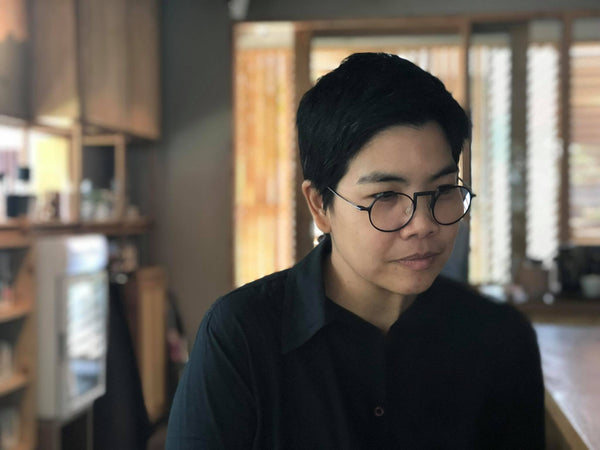
“And another thing I like about this brand is that because I work with many types of clay, Pottery Clay offers a wide variety of clays to choose from. I can shop according to the type of work I'm doing. All in all, it saves me the trouble of flying abroad to get them myself. Especially now that travel is restricted, buying through Pottery Clay is an excellent option for artists and potters like me.
"But for those who want to pursue ceramics professionally, I recommend building a strong foundation in ceramic basics. This is crucial because it will connect to how to prepare raw materials, experiment with glazes, store materials, and manage tools. Once you have a strong foundation, you'll naturally discover what techniques you want to pursue. Then, it will narrow down what you truly need and what tools are suitable for your work. Everything will become more focused, and you'll increasingly find your own unique path in ceramic art."
For Aor Suttiprapha, she may have found her preferred style of ceramic work today, but that doesn't mean she will stop there. Ceramic work is unpredictable, and the materials used to create pottery can still evolve in hundreds, even thousands of ways. More importantly, she doesn't see ceramic work as something that will make her famous, but rather as something that provides her with insights and perspectives on work and life more than she ever imagined. As long as you find the perfect harmony between the potter and the materials, you will easily discover the ultimate in ceramic art, just as she has.